QuickTwist
Permanent Fixture
Surprise: I knew already

I think one of the biggest differences between us (which this test doesn't really track) is that you tend to be more humorous and I tend to be more serious.

Surprise: I knew already
I think one of the biggest differences between us (which this test doesn't really track) is that you tend to be more humorous and I tend to be more serious.

I think one of the biggest differences between us (which this test doesn't really track) is that you tend to be more humorous and I tend to be more serious.
Or at least lighthearted. Could be an overlap with humorous, but I think lighthearted is more accurate.

Free open-source BigFive personality traits test
Take a free, open-source Big Five personality test. Learn to know your personality traits and compare yourself with your partner, colleagues, friends or family.bigfive-test.com

The 120-question test is clinically validated.Just a note about this test. While it does measure certain things, and may even be asking the right questions the right way, it is another example of trying to measure so many things that to do so would probably require asking more questions. I can't remember how many questions the test by Jordan Peterson is, but I would wager it is more than 120 questions, and it only measures 2 aspects of the Big 5 dynamics. Therefore, it is "honing in" on much more depth with the questions answered for more consistency and accuracy.

The 120-question test is clinically validated.
Also, don’t tank your credibility by referencing a known charlatan.
Cheers,
Ian
What makes Petersons Big 5 more "honing in on traits".
Just curious because all I saw were 5 numbers.
Does he explain them together as there would be 2^5 ways of representing personality (32 ways)?



Meaning, it has been tested by double-blind, randomized, and controlled clinical testing with peer review, and repeatability.120 questions are clinically validated for what?
All of them. The published literature is free for you to review.For how many aspects of the Big 5 dynamics does that account?
Clearly, yes. The testing of the hypothesis repeatability, with peer review and analysis, has demonstrated that.In short, I do not doubt that it may accurately represent the 5 dynamics of the Big 5 (Neuroticism, Extroversion, Openness to Experience, Agreeableness, and Conscientiousness); I doubt only whether it accurately measures the sub-category aspects of these. In other words, per sub-category aspect, it only asks you four questions. Is answering four questions about a dynamic of personality a good methodology?
We do not know that. That might be true, and it might not be true. We do not know, because it has not been clinically verified.Let's say that Jordan Peterson's test also asks 120 questions. In that case (and it could be a 200-question test, now that I think about it), it is asking 12 questions per sub-category aspect of the Big 5. That would mean it would be much more consistent and accurate to account for outliers and such.
Fair enough, so you are free to dismiss it.As far as your accusation against Jordan Peterson, I'd need some serious evidence that he is a "charlatan." That is a claim, a very heavy claim, as an accusation against another person stated with zero evidence.
So a pastime. But not science. No peer review. Nothing clinically validated.Also, I wanted to mention that Dr. Peterson did his own assessment for this test, meaning he asked 10,000 people and measured their responses. Then, when you take the test, your answers are compared to those of the other 10,000 people.
We do not know that. That might be true, and it might not be true. We do not know, because it has not been clinically verified.
So a pastime. But not science. No peer review. Nothing clinically validated.
Yet he presents it as if it means something and can be used by individuals in their own self-discivery.
Hence, charlatan.
Cheers,
Ian
Agreed. That said, the 120 question version is the one which has been clinically verified.1) There is nothing magic about asking 120 questions. It's not that if you ask 120 questions, then it is validated. It also matters which questions you ask, whether they are controlled, and whether they measure what they purport to measure. 120 questions by itself doesn't tell us anything.
If that is your level of understanding, I will leave you to it. The research papers are out there for your review. If you wish to call it a random test, so be it. Based on your past behaviors, I have no expectation you will be reasonable, so for me to continue would be to act in bad faith.2) Well, I mean, if you want to be completely uncharitable, then that is fine, but Dr. Peterson is a doctor and has a valid degree to measure such things. It would be very surprising to me if it were not the case that I mentioned. And as easily as you say Jordan Peterson can't be trusted, IDK why I should be more likely to trust some random test on the internet just because it is free.
No, not at all, and don’t ascribe to me something I never said. I do not concern myself with magic, so I will leave that with you.And yet you think there is some magical threshold for asking 120 questions on a free test...
Agreed. That said, the 120 question version is the one which has been clinically verified.
So yes, 120 questions is immaterial. The verification is certainly otherwise.
If that is your level of understanding, I will leave you to it. The research papers are out there for your review. If you wish to call it a random test, so be it. Based on your past behaviors, I have no expectation you will be reasonable, so for me to continue would be to act in bad faith.
No, not at all, and don’t ascribe to me something I never said. I do not concern myself with magic, so I will leave that with you.
Believe what you like. Simply know that if you do so, remaining wilfully ignorant of the basis in research, you argue based on nothingness.
Cheers,
Ian
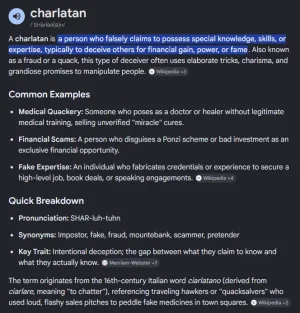
From Google:@aeon, this is what you are accusing Dr. Peterson of. He does not fit any of these characteristics.
View attachment 102446
That’s your opinion, and not of my concern, but thank you for your honesty.This whole post is really passive-aggressive.
From Google:
The "Jordan Peterson grift" is a common critique leveled against the Canadian psychologist-turned-cultural commentator. Detractors argue that he uses pseudo-intellectual rhetoric and alarmist political commentary on topics outside his expertise to monetize his massive following through paid platforms and speaking tours.
Critics point to a number of common themes when discussing the "grift":
Cheers,
- Monetization of Academic Credentials: Critics allege that Peterson leverages his former academic title to speak authoritatively on complex topics outside of his clinical psychology background—such as climate change, evolutionary biology, and gender studies—to generate traffic and revenue.
- Contrarian Content: Skeptics, including groups that track online phenomena, claim that his polarizing positions on "woke" culture, feminism, and traditional values are highly performative, designed to inflame cultural tension while bolstering his brand.
- Peterson Academy: Launched as a controversial, online-only "alternative to traditional universities", this platform drew heavy criticism from within his own audience as being a superficial or "grifty" way to cash in on education, offering courses with simplified grading formats.
Ian
The NEO-PI-3 (Revised NEO Personality Inventory-3) is the gold-standard, scientifically validated psychometric assessment that measures the "Big Five" personality domains and 30 specific subordinate traits. Developed by Costa and McCrae, it is widely used in clinical, counseling, research, and workplace settings
The official test publisher, Psychological Assessment Resources (PAR, Inc.), released a major Normative Update between 2024 and 2025.
- The Purpose: Over the course of 20 years, shifting cultural standards, technology adoption, and micro-generational changes rendered the original 2005 benchmarks slightly outdated.