Intuition - Origin and Definition

Telepathy Tapes S2:E6 - Psychedelics and Accessing Consciousness

Children were lost in the Amazon rainforest for weeks [after an airplane crash] when a shaman used Ayahuasca to find them in one day by expanding his consciousness to be one with the rainforest. He used the senses of all the biology within the jungle and it led him to the children.

Summary: This episode blends Indigenous knowledge, historical analysis, and modern science to argue that psychedelics are both:
  • A therapeutic breakthrough for mental health, and
  • A re-emerging pathway to expanded consciousness and spiritual connection
It positions current research as part of a larger rediscovery of ancient human practices that were suppressed but never fully lost.

Disclaimer: This material is provided for educational and informational purposes only. It discusses psychedelics, which may be illegal in certain jurisdictions and can carry physical and psychological risks. This content is not intended as medical, legal, or therapeutic advice. Always consult a qualified professional and follow applicable laws before considering any related practices.

Section Summary:​

1. Introduction: Expanding the Inquiry into Consciousness​

The episode builds on prior discussions of telepathy and plant communication by shifting focus to psychedelics as tools for accessing expanded states of consciousness. It frames psychedelics not just as substances, but as historical and cultural gateways to intuition, perception, and connection with a broader “collective field.”

2. Case Study: Amazon Rescue and Indigenous Knowledge​

A central story recounts the 2023 rescue of four children lost in the Amazon. While military efforts failed, an Indigenous shaman used ayahuasca (yage) in a ceremonial context to locate them.
  • The shaman describes entering a state of shared consciousness with the jungle.
  • He claims to perceive through animals and nature itself.
  • The children were found shortly after his guidance.
This story is presented as evidence of an Indigenous worldview where consciousness is interconnected across humans, animals, and the environment.

3. Indigenous Perspective: Psychedelics as “Technology”​

Indigenous leaders frame psychedelics as:
  • Ancestral technology for accessing spiritual realms
  • A means of communicating with ancestors
  • A tool for navigating life, death, and cosmology
Ayahuasca is described as a “cosmic plant” that enables interaction with other dimensions and forms of intelligence.

4. Historical Context: Psychedelics in Ancient Civilizations​

The episode challenges the assumption that psychedelics are limited to Indigenous cultures by presenting evidence from:
  • Ancient Greece (Dionysian rituals)
  • The Eleusinian Mysteries (Kykeon potion)
  • Archaeological findings of psychoactive substances (ergot, cannabis, opium)
Scholars suggest that foundational Western thinkers (e.g., Plato, Socrates) may have participated in psychedelic rituals that shaped spiritual and philosophical thought.

5. Loss of Western Traditions​

The decline of psychedelic practices in the West is attributed to:
  • Roman Christianization
  • Destruction of pagan temples (e.g., Eleusis)
  • Suppression of ritual knowledge
The episode argues that this led to a broader cultural disconnection from direct spiritual experience and the “divine.”

6. Global Continuity of Psychedelic Use​

Despite Western suppression, psychedelic traditions persisted globally:
  • Africa (Iboga, Kanna)
  • Asia (Amanita muscaria, Soma)
  • Americas (ayahuasca, peyote, mushrooms)
These practices are framed as universal human behaviors tied to spiritual exploration and healing.

7. Modern Therapeutic Use: Mental Health Breakthroughs​

The episode shifts to contemporary research showing psychedelics’ effectiveness in treating:
  • PTSD
  • Depression
  • OCD
  • Addiction
A veteran’s story illustrates rapid emotional healing through guided psychedelic therapy, emphasizing:
  • The importance of preparation and integration
  • The role of trained facilitators
Clinical research (e.g., Yale studies) suggests psychedelics promote neuroplasticity, enabling lasting psychological change.

8. Mechanism: Neuroplasticity and Cognitive Reset​

Psychedelics are compared to:
  • Breaking rigid mental loops (e.g., OCD patterns)
  • “Resetting” brain pathways rather than gradually altering them (like SSRIs)
They create a temporary state where the brain becomes more flexible, allowing new perspectives and emotional processing.

9. Spiritual Experiences in Clinical Settings​

Even in controlled medical environments, participants report:
  • Feelings of unity and oneness
  • Encounters with deceased loved ones
  • A sense of connection to a greater reality
Researchers acknowledge these experiences as psychologically significant, even if not fully understood scientifically.

10. Tension: Medical vs. Spiritual Frameworks​

A key theme is the mismatch between:
  • Western medical models (focused on symptoms)
  • Psychedelic experiences (often existential or spiritual)
The episode argues that current systems lack the language and structure to fully interpret these experiences.

11. Suppression and Survival of Knowledge​

The transcript highlights that:
  • Women historically preserved psychedelic knowledge (herbalists, “witches”)
  • Witch trials and persecution targeted these knowledge keepers
  • Some traditions may have survived underground
This reframes “witchcraft” as a continuation of ancient pharmacological and spiritual practices.

12. Core Thesis: Rediscovering a Lost Human Tradition​

The episode’s central argument:
  • Psychedelics are not new—they are part of humanity’s deep past
  • They were once integrated into ritual, healing, and community life
  • Modern society is “remembering” rather than discovering them
The loss of these practices is framed as a cultural rupture, not a natural progression.

13. Broader Implication: Consciousness Beyond the Individual​

The episode ultimately suggests:
  • Consciousness may be shared or interconnected
  • Psychedelics could provide access to this broader field
  • Human beings have an inherent drive to explore beyond material reality
 
Stuart Hameroff Discussing Consciousness Related to Psychedelics

The scientists thought that the brain would light up during a fMRI scan when a subject was under psychedelics but the exact opposite happened. The video shows a high level concept of why Hameroff believes that consciousness is non-local. Hameroff and Penrose developed a theory on consciousness (Orchestrated Objective Reduction) that has been gaining a strong following in the scientific community.

The reason I think this is important and relevant to intuition is because it attempts to connect a more collective consciousness and perhaps that is how a high level Intuitive "knows" things before happenings. This is not to suggest that the senses don't play a role, only that the origin is separate but interconnected to the body.

 
Sound can go through just about anything.

Tap on a rock wall and hundreds of feet away you hear it almost instantly.

If the frequency of the brain increases time slows down because you experience more in each moment.

So we could say quantum "vibrations" would become detectable if they operate at high frequency and travel through materials and space.

The brain would be sensitive enough to pick up on them. Like bats can travel in the dark.

Though neural plasticity is a structure that it takes time to change connections to involve such sensitivities.

Instead microtubules would induce the cells to resonate faster which the synapses would transmit.

But that would make them antenna for such a field. They would not change the normal operations of brain function like walking.

Since the world is slower we just need attunement to everyday life. To control the body which does not move that fast.

In dreams we do not try to keep consistency of the real world. Many forms come together that do not when awake. Its more fluid that way.
 
Stuart Hameroff Discussing Consciousness Related to Psychedelics

The scientists thought that the brain would light up during a fMRI scan when a subject was under psychedelics but the exact opposite happened. The video shows a high level concept of why Hameroff believes that consciousness is non-local. Hameroff and Penrose developed a theory on consciousness (Orchestrated Objective Reduction) that has been gaining a strong following in the scientific community.

The reason I think this is important and relevant to intuition is because it attempts to connect a more collective consciousness and perhaps that is how a high level Intuitive "knows" things before happenings. This is not to suggest that the senses don't play a role, only that the origin is separate but interconnected to the body.

I just wanted to let you know, I've watched this from start to finish and enjoyed every minute. Thank you for sharing this vid; it was very interesting.
 
Carl Jung's Synchronicity

While Jung did not equate synchronicity with intuition, he implicitly linked them by suggesting that intuition is the psychological function through which meaningful, acausal connections between inner experience and external events are recognized.

The video explores the idea of synchronicity, a concept developed by Carl Jung to describe coincidences that feel deeply meaningful rather than random. It begins with the striking example of Mark Twain’s life aligning with the appearances of Halley’s Comet, illustrating how certain events can appear too precise to be dismissed as chance. Jung argued that true synchronicities are not just coincidences but involve a meaningful connection between an internal experience—such as a thought, dream, or emotion—and an external event, occurring close together in time without a direct causal link. Through examples like the “scarab beetle” incident in therapy, the video shows how such experiences can feel psychologically significant and even transformative.

Building on this, Jung proposed that synchronicity points to a deeper structure of reality in which mind and matter are interconnected, emerging from a unified source he referred to as unus mundus (“one world”). This challenges the conventional scientific view that events are only linked through cause and effect, suggesting instead that meaning itself may connect experiences across the inner and outer worlds. However, the video also acknowledges skepticism, noting that humans are naturally inclined to find patterns and impose meaning, and that synchronicity remains scientifically untestable. Ultimately, the concept raises important philosophical questions about the nature of reality, the limits of human understanding, and whether meaning is discovered in the world or created by the mind.

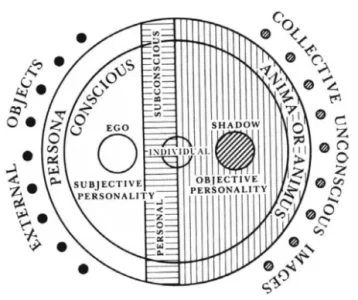
Within the following diagram, synchronicity is not confined to a single part but represents the meaningful alignment between internal psychological processes and external events, emerging across the entire structure as the psyche and reality momentarily reflect one another.
1777396762322.webp
Although this diagram presents the psyche in distinct sections for clarity, Jung understood these elements as deeply interconnected and fluid, continuously interacting and integrating through a dynamic process rather than existing as fixed or isolated parts.
 
Synchronicity is a product of dualism mind.

Things cannot be related because of no-thing-ness and uni-verse.

Singularity, is-ness.

Of course this cannot be proven or measured.

Can it be experienced? I will offer yes, it can.

Jung knew. Or he at least intuited that truth.

Cheers,
Ian
 
Some of Jung's own words on Synchronicity

Quotes:
"It is more often than merely probable... people hate such problems, they can't deal with it."
"Relativation through time and space through the psyche, that's the fact."


People are afraid to talk about it for fear of rejection. People self suppress and this prevents the growth and innovation of the mind. I know we have made progress in this area but people are still slow and resistant to accepting the idea of synchronicity. It happens to me nearly every day and I usually say nothing - it's only when I feel like it will really help someone that I choose to be vulnerable.
 
Back
Top