Intelligence Question (IQ)

Fruiteloop

Community Member
MBTI
INFP
Enneagram
7
There are varieties of intelligence because of MBTI

The front brain and back brain, the left and right brain. Combine in different ways.

I have trouble with drawing because I cannot see textures but I assume that people with a good vision network has a dense mesh of connection to see better.

The front of the brain can do two things. Reflect on what needs to be done and plan out many things to be done. And utilize vision to execute those plans.

So executive function is about thinking and doing. People without it can do things but not so much plan things.

So I was thinking that the more you plan and the more you see the more you can do.

Since not everyone is the same (density of connection is different in different people and areas of their brain) what factors are involved in quantifying intelligence?

I do not mean that intelligence can be reduced to a single number (Intelligence is more 3 dimensional than 1 dimensional) but what can we say in absolute terms can people manipulate both internally and externally to say they are more intelligent.

Overall the best I came up with is that people who have more working memory and perceptual memorization would be what to look at.

These people could do pretty much anything they want to do just by thinking about what needs to be done.

This would require understanding working memory.

Practically speaking this would require understanding the wired connections that allows more information to be processed together.

What does a brain look like that connects to itself?

Something like a human computer?

The front brain and back brain would work together.

The reason I have these questions is because in movies people make digital art.
I never could make those things so instead I tried to understanding why others could.

The vision system then is what I wanted to know about but this only was at first because executive function I have seen are not really on IQ tests.
Executive function is also important because it allows you to do step by step and hold parallel instructions at the same time.
So it allows you to know what when and where to do things. I had trouble with it so I wanted to know more about it.
 
I don’t know what to say other than there is some validity to mapping brain function to areas of the brain, but the areas are much more granular than left/right, front/back.

Also, I am neurodevelopmentaly disabled on account of being diagnosed with ADHD, primarily inattentive, severe presentation.

Did that have an effect upon my IQ? Who knows. I have always been me, so I don’t know anything differently. And no, I am not going to say a number, or speak further about that.

One thing often said about those with ADHD is they have difficulties with executive function, to greater and lesser degree. Yet this often manifests as knowing what to do, how to do, being oriented properly, but having no fuel in the tank.

I have had fMRIs done at baseline, and on 30mg methamphetamine hydrochloride. While my activated total area changed, the core areas were the same.

Yet also, expected areas when I was shown eliciting images—and particularly so when I listened to music—were significantly (in the statistical sense) different than normative controls. I also had non-responses to eliciting images which produced activity in normative controls.

Political and intersectional critiques aside, I think the Wechsler and Stanford-Binet are useful in the assessment of fluid and crystallized intelligence. Like any test, one must incorporate that assessment in a much larger, holistic context for it to be functionally useful.

Cheers,
Ian
 
I see.

Yes granularity is the thing. Like I said the density of neuronal connections.

However the energy part may be the issue with ADHD does not lower intelligence because the wires are still in place they just are not active all the time.

Not sure how I am in the sense that I can do some things and not others, I simply have less connections is vision centers maybe?

I spend my energy on tasks until I cannot do them anymore because if I don't I cannot sleep.
it is just that I cannot sit still and do nothing even for brief moments.

Some people plan better than I do, in real time that is because I have to follow a routine or get messed up by losing things. Important things. Such as I have a list in my wallet. I cannot spend more than a certain amount at the store a day on food. And I stay home until the next activity. I don't drive a car. It was too hot to do laundry today (I cannot walk two blocks in the sun) so I have to make sure to get help or not have clean cloths. I forgot the soap once, had to walk all the way back home to get it.

If I do something it has to be right in front of me or I don't know what to do. I think it out but often my mind gets blank.

Its like I said on Ti (I do not reflect on stuff in this way) I can plan sort tasks but I cannot go into depth of all the connections of everything in a structured manner. Some people can design elaborate things sitting in a chair just thinking. To me I feel slow doing it. It is a reason I read and critique more than I flesh out math equations or draw diagrams of complex models. Forcing myself to think hurts if done incorrectly.

So what I am saying is that I need to see it to do it, puzzle games or work. but just thinking about it the brain hurts as it doesn't generate things on it own in me. Its external generation not internal generation if that makes sense. Like writing what I have here.

A person that draws comic books. That is what I have trouble doing is being creative. I can put things together mechanically but not really create designs. It feels like I have nothing to do allot so thinking to me is about describing what could be. Rather than making it.

To me knowing what to do would be structured thinking.
The thinking that require creative reflective design.
I absorb ideas all the time.
but it is the generative processes, they seem like what I want to do but cannot.
understanding them is still cool because I get to see a little bit of it happening in me at a time.
 
I thought more about what thought is.

Some people think in pictures some people think in words.

If you think in feelings that is complicated because feelings are negative or positive meaning your having a good time or bad time with them.

Some people can summon feelings into being. Feel what they want.

And music, people can think in music as well.

In me, my feelings just are negative but I can look exterior to myself and stop them being so.

External sensory stuff is a distraction from feeling for me.

Be as it may, there needs to be an object of thought to analyse as it were.

You can synthesize thoughts but I have trouble knowing what that is since analysis requires parts and synthesis is smoother and holistic.

Analysis is bottom up synthesis is top down. Top down as in you have a big picture idea and fill in the details. Analysis is taking it apart.

I am better at taking things apart.

When there is a big picture I am able to work with it but not mentally but physically.

I think there is a bit of metacognition at play when people can make up stuff in their heads.

The objects of thought can be made up not corresponding to anything exterior.

But to do so there needs to be this imagination box inside the person.

This could be the meta layer of the human brain.

Often I come across what is termed the default mode network.

Now some people have control over their imagination and others do not.

But it comes from the imagination box.

I have many ideas but I cannot control them, I cannot imagine things well(past or future).

I think my box is broken or something because I do not see anything or hear anything when I try and create stuff.

The imagination box would be a higher level of intelligence in humans something IQ tests don't measure.

The degree to which people can control imagination is a new stage of development perhaps because I never hear it talked about?
 
Last edited:
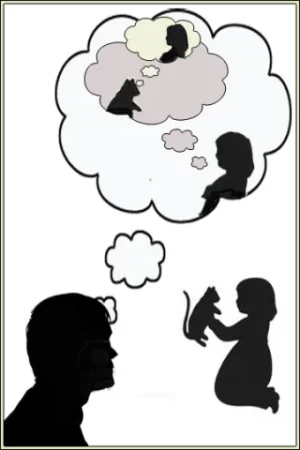
Theory of mind can go about 5 levels deep or deeper.

In this image it is 3 levels deep but the cat could also think about how the girl is thinking about the cat making 5 levels for the person looking at the cat and the girl.

cat girl theory of mind.webp

At the 7th level where book authors write stories then is where I tell you about the man looking at the cat and the girl and wonder what you yourself are thinking and if I were good enough predict what you think about me thinking about the man cat and girl.

I do not usually think about what others are thinking but this came about by this model of thinking in this video about Lev Vygotsky.

He demonstrates that kids have inner speech, what they talk to themselves in their own heads self regulates them and they can develop faster if shown how by adults who know more.


Whereas people that have had more help learn and develop faster we see that they can do extraordinary things beyond what is normal stages of development.

I never developed the ability to see things in my mind so I cannot design things in my mind, I barely talk to myself.

Talking out loud to people I am really good at but when it comes to self regulation I have real bad problems keeping myself stable at times.

That is why looking into what all this does I came across the terms self monitoring and cognitive control.

This could be something to do with human level intelligence.

If you cannot control yourself because you cannot see how you think then you fail to act intelligent even when you can see what to do.

So first one needs to reflect on one's own thinking and notice how it works.

This could also be about body awareness because you can control the body easier and if you can control the body you can control the mind to the same degree.

Like how the eyes can go places we could notice where we are looking just as we can notice what we are saying and control it.

In a social setting we must understand how people are by understanding ourselves first or we will be uninhibited in what we do.

Vygotsky says we make use of our self control by modulating others as they modulate us. This creates self awareness.

It is that imagination box I talked about. It can get bigger the more we use it.
 
I forget the details, but Ni-doms achieve better/more when left more alone.
But they do need a social check-in and encouragement.
I think it's a lot more nuanced as far as social learning goes, but there's definitely an important component there.

Also if you don't even know something exists, there's no way to practice it and therefore get better at it.

I've said it many times before in various ways but, the things that we don't know, that we don't know, are the real dangers.
It's also a big component of gatekeeping.
 
I forget the details, but Ni-doms achieve better/more when left more alone.
But they do need a social check-in and encouragement.
I think it's a lot more nuanced as far as social learning goes, but there's definitely an important component there.

What do you think is most correlated with social understanding? Or how does it work?

Also if you don't even know something exists, there's no way to practice it and therefore get better at it.

I've said it many times before in various ways but, the things that we don't know, that we don't know, are the real dangers.
It's also a big component of gatekeeping.

Rumsfeld got his phrase: the unknown unknowns from NASA

As an organization they gate keep many things I suppose?

Not just them but people are selective in any group and are why some still exist.

I agree that learning requires knowing something exists. I keep this in mind all the time because how large the world is, I cannot make a car for example but the first car must of taken work to make with machine tools that needed to be made first by blacksmiths and their funders. Steam engines were made first but the combustion engine I have not looked at its history yet.
 
What do you think is most correlated with social understanding? Or how does it work?

That's a big question.
It's some mix of many things.
An ability to observe is important.
Motivation and enjoyment are integral.
Some other traits as well I'm sure.
 
The mind naturally deals in abstractions.

People who do math they can do it the same as normal people learn language. If you read a book for example, a fictional book of a story on some topic. Let's say it is 200 pages. Then the same can be done with math understanding until the math is intuitive enough to the person to just do it. So writing a story of 200 pages is just as easy as writing 200 pages of math equations as long as you store the math in the brain on an unconscious level the way language is stored. Then you can generate the math the same as words on a page.

IQ tests do not and cannot define language skills because it is about storytelling and that cannot be quantified.
The SAT might be able to show how good at math you are and reading but it is not the same as creativity.

I was doing a test from the mega society called the Hoeflin power test.
I did not score high at all and you are only allowed to take it once. There is no time limit on it.

Supposedly this test can see if you are 1 in a million intelligence level (8,000 people have this IQ on the planet)

So it was made to be really hard to do.
Lots of math but no vocab.
I spent a long time on it but got burnt out.
There were so many things to be taken into consideration.
Yet I went to fast and maybe I was not well at the time.
Often I do math problems but I am not as good as I am at language.
Language is so much harder to evaluate than math and is why it was taken out of these tests.

After a couple of months I went back and reviewed what I did. I am not allowed to share my answers but I will say that I was much better at understanding what I did wrong and with less stress than before. I keep trying to think about what good it is for that these tests exist, if a person can do hard math then they just can. What matters is that I was trying to see if I could do it. I have things I want to do but they require either going to school or finding someone to work with. I have several ideas I cannot do by myself.

I am going to get a job soon as a janitor but I have no plans on anything else.
To be able to go to school I might need to buy a car and learn to drive it. (I really don't want to)
But if I am a janitor I can buy things with the money I make.
I might for example buy books online and another computer.
I am still not sure what it is I can do. I need to keep busy with myself.

Understanding intelligence is just part of what it is I have to do.
Reading books on other things will allow me to consolidate what I know.
It might help me get ideas on what to do in life.
There are many things I can do if I get the money.
 
As far as IQ goes, what about spatial IQ? I think the mind integrates comparisons, math, repetition themes, even imagination when solving some IQ questions. Imagination can be tested as a part of something. I have to imagine which picture would be next in a sequence but still use other means of thought.

Critical thinking, for example. It involves so many different ways of looking at something, yet most of it is done quickly and powerfully. There was a short presentation I read earlier today that showed how highly intelligent people often feel. Some are lonely, some are not fitting in because nobody can talk with them on their level of thinking. There are prices to pay for being highly intelligent. Wish I could find that article.


Here it is. People do not understand "different" and how to interact with "different". Well, mostly. I would almost bet someone like this would score better if home alone. Many lack the tenacity to follow others, while some almost get bored at times. One would almost think someone with a high IQ would know how to interact without getting bored or wandering away into a part of what they heard to expound on in their minds. IQ alone does not tell me how smart a person is. It is a well-accepted way of seeing where someone might stand, but there are always things we do not see.

@Fruiteloop , your not being able to see well is almost a telltale sign you have a higher strength somewhere maybe you have not noticed yet.
@aeon , I KNOW you well enough to know your response to music was higher than most other things.
 
Last edited:
@Fruiteloop , your not being able to see well is almost a telltale sign you have a higher strength somewhere maybe you have not noticed yet.

I did some research and it turns out that the way people view big picture thinking vs detail oriented thinking is askew from they way psychologist view this subject.

The doral system of the brain in vision is based on spatial and the ventral visual system is based on details or textures and objects.

So I am good at seeing things in space but cannot do textures colors or details.

People that draw good as in they can draw anything, they have both texture and spatial intelligence.

So they are considered big picture thinkers even if they can do details also.

A doctor once called me detail oriented but I cannot do textures at all.

-

I made a list of the three layers of cognition I believe are at play in intelligence

The top meta layers is where we evaluate and self correct our errors mistakes and monitor ourselves.

Working memory the second layer and is where we can manipulate data / information.

Perception is the base layer. Here we have pattern recognition, emotion, memory, physiology.

Intelligence then uses all three. We "tell" ourselves what is whats up with ourselves by inward self talk / imagery.

We can tell ourselves to pay attention, tell ourselves what we are doing might be right or wrong and should change gears.

People who have self awareness usually make fewer mistakes, know what to do, can think ahead, self regulate good.

Because I have a deficit in seeing details I have blind spots, minor errors go wrong the whole plan I have goes wrong.

So I account for as much as I can without overwhelming myself.

I know what the biggest things I need to do first are which cannot go wrong just because I mest up some small thing.

Like how I always know what to do if I keep my list on me of my top priorities.

This keeps me on track. I can do what I need to do. Like my projects.

I write things down on a physical paper notepad. I sit at places such as Taco Bell and Wendy's.

I always try and make sure the idea works and test out what it can do by showing my work. Constant refinement on it.
 
I write things down on a physical paper notepad. I sit at places such as Taco Bell and Wendy's.
I can easily relate to this. We write things on a piece of paper as we run out or get low for grocery stores. When I have the time, or remember, to rewrite items before I go to the grocery store, I write them in order as they are in the store I am going to. Last time I went, there were only a dozen different things we needed. I also added some things I would like as snacks, like peaches and plums. When I arrived at the grocery store, I automatically went to the drink aisle first. They were not first on the list. We buy three 12 packs of drinks, and it is so much easier to put them in the cart first than later. From there, I grabbed things on the list if I passed them while going where I usually start.

I went through the list in my pocket without ever looking at it. When I was finished, I took the list out for review. Didn't miss a thing. Had I just taken the list all mixed up from the fridge, I would have been checking things off as I grabbed them. Usually, I miss something(s) while looking at the list several times. My mind adapts easier to fresh memory and orderly fashion, though there are papers all around my computer desk and on the floor.

I know I should stop and place things in order in the house, but a paper on the floor means a documented thought or idea that has been finalized. If I stop writing, I can easily get side-tracked.

I can relate to constant refinement, like while I wrote a Trust last week. One can pay $39 for a Trust, but it would not show the refinement my mind needs before I can accept it as being a final doc.

Question: who told you about your lack of seeing details? I have also found the human mind capable of "believing" something, then enacting it. There was a young man I went to see on visitation that had just lost the use of his right hand forever due to cut nerves and such. I was representing a church, so I stayed biblically focused. He told me what had happened and what the doctor said. I asked him if he believed the doctor. He said yes. I then told him God says he will use that hand again and asked who he would believe: God or a doctor. He asked how? I told him to work both hands simultaneously if needed, but to work on his hand every spare moment of every day trying to get it to work. We prayed with his mother, and I left.

A few years went by, maybe two to four years. I was at a funeral when he ran across the field and shook my hand firmly with the hand we had discussed. His smile told me so much.
 
Question: who told you about your lack of seeing details? I have also found the human mind capable of "believing" something, then enacting it.

No one told me, I just can not do it.

I have drawn many technical schematics before but when I tried to draw faces I cannot.

It is about organic things I have trouble with. As I said colors and textures and lights and shadows.

My sister can draw puppies and kitties with fur and stuff I cannot do. they look real.

Also I walk in the grocery store and need to look at each item on the shelf if I am trying to find something.

Yet I am also able to play puzzle games or other kinds of games where I can orient myself to be in certain positions to hit targets.

This is why I think the separation between the dorsal and ventral stream makes sense.

These two streams are in the back of the brain and where vision begins to separate into objects and space.

Most of the time I read allot and do not look at things in detail so this could be the reason I cannot see small things.

I am in my head allot but I never look at stuff just to look. So it can be blurry.

I never practice just looking but my sister looks at stuff for no reason all the time.

The mechanisms involved are complicated and why I am still researching it.
 
You can see faces, right? I cannot draw faces well, but I have the ability to look at a picture and draw it on a manila paper. I can only copy things I enjoy, such as a fish. A face? It must be of importance to me to get a good drawing. My mind doesn't cope well with drawing a gazebo, for instance. I get no enjoyment out of it. It may bring serotonin into the picture. Also, my mind does not want to spend the time creating something that has already been created. My mind wants something creative: something new. It will block out things and abilities like yours blocks some visual concept of details. I have tried to reason with it, but the only thing that makes sense to me is preferences.

I sketched in pencil in grade school a picture of a muskellunge, a large predator fish with sharp teeth. It was supposed to be in color, but color would have ruined it. My mind accepted it well with pencil and different shades. The teacher gave me an F and said it was supposed to be colored. It was amazingly accurate, but I colored it and turned it back in. It looked awful to me then. Funny how my brain accepted the pencil form as being colored. I threw the pic away after getting it back in the teacher's trash can.

Translation of sight onto paper requires skills, to do it right. Some people do not have those skills. I can sketch but have problems with the colors. Just bought an oil pencil set in a wooden box at Goodwill for under $5. I saw it and reflected back to the fifth grade of school and what that picture could have looked like, if I had the right tools. Life goes on.

Can you draw something your heart and mind truly loves?
 
Can you draw something your heart and mind truly loves?

Right now I am focusing on reading as such I might have time to look at more things to practice improving my vision but drawing is not a hobby I enjoy for the sake of it. I think people enjoy drawing when they have something the want to draw and I have not done so since 8th grade. All my ideas became too abstract to draw and more mathematical.

It is good that you can find something to draw that you like to draw. You will get better at it I hope.
I am looking at trying to improve my emotional state with therapy and more body exercise.

I think that the three layers I came up with of intelligence are a helpful model to me.
The meta layer the working memory layer and the perception layer can all be mapped onto real brain structures.
Self monitoring especially helpful since I lack some basic proprioception (inner body awareness)

The reason some people have trouble with meditation is they cannot feel their body, thoughts make them quit.
But I have been body scanning for a couple of days now and it helps in making thoughts clam down.
Reading topics on psychology and talking to friend has alleviated some stress in me I had not noticed before.

I still think intelligence is important and want to continue understanding it.
They have this method called the growth mindset which allows you to be positive in learning.
Most of what blocks me from learning is depression so I have been gradually reducing it to learn faster.

I do believe I am limited because of course smarter people exist but I have to try things for myself and make it fun.
I have my math papers and charts and need to show them to someone who will give me feedback.
To do so I require fixing some things at my house, my dogs need to be safe.
But then I will be free to try more things, this will make me less bored.
 
INFPs guard their inner world like a small flame in the wind.
INFJs interpret the world. INFPs feel the world.
Your brain doesn’t naturally break the world into lines, angles, and proportions.
It breaks it into feelings, concepts, and impressions.
The INFP imagination is rich, emotional, symbolic — but it’s internal, not external. This is most likely why you enjoy reading and math so much. An INFP enjoys symbols. An INFP does not need pictures to understand something: they enjoy feeling the meaning of something.

Read on, my friend. It is part of who you are. You would find it rewarding and possibly abstract if you would draw the kitten the way you see it and feel it, instead of what it looks like to everyone else.

You don’t have to draw to be creative. Reading is its own kind of art — it lets your mind paint in ways a pencil never could.

Edit: By the way, I have yet to experiment with the oil pencils. I like to express with words and actions.
 
Last edited:
Back
Top