
I do not understand Bayes Theorem

@Fruiteloop here is an old notebook I made when he released that video.
https://observablehq.com/@laotzunami/primers-coin-game

You were talking about normal distributions. I'm doing my calculation using a beta distribution, which is great for a binary outcome like flipping a coin. Since we know there is an even number of fair and cheating blobs, and the cheaters get heads 75% of the time, you can just take the height of the beta distribution at those values. Then if you know the payoff, you can decide if it is better to pay another coin for another flip, and make your guess.
1785207661638.webp
Adding more variable can make this situation more complex. Like I said, I've been wanting to make something about Bayesian stats for a while. If you are serious, I could make a friendlier introduction or more sophisticated model. But this is a clear example that doesn't require a neural network.
 
@Fruiteloop here is an old notebook I made when he released that video.
https://observablehq.com/@laotzunami/primers-coin-game

You were talking about normal distributions. I'm doing my calculation using a beta distribution, which is great for a binary outcome like flipping a coin. Since we know there is an even number of fair and cheating blobs, and the cheaters get heads 75% of the time, you can just take the height of the beta distribution at those values. Then if you know the payoff, you can decide if it is better to pay another coin for another flip, and make your guess.
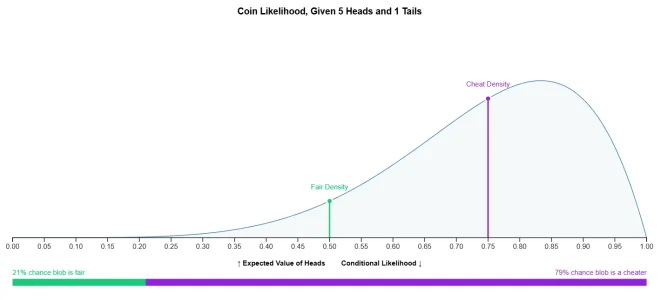
View attachment 103209
Adding more variable can make this situation more complex. Like I said, I've been wanting to make something about Bayesian stats for a while. If you are serious, I could make a friendlier introduction or more sophisticated model. But this is a clear example that doesn't require a neural network.

It be interesting to know because even though I have not been classes on this subject it help me learn something for practicality.

That is to say I would like to understand how I can use it to help me with problems if I need to gather data or us data I have.

Most introductions never go beyond basics and the advanced stuff would not help without intermediate steps but if there were a way to cross between those it be nice. Like a step by step on what its good for and what I can do with it.

I know that in math you can derive certain equations with pure theory, I am not asking "what formula do I use" it is more like that if it was step by step than I could think about how to becomes good at doing science stuff, like understand how to create experiments to test ideas but with proper math involved. I am at this point where I have not been to school a long time but I have life experience to know how the dots connect if presented correctly.
 
@Fruiteloop Would you be okay with starting with a simple probability game, like flipping a coin or rolling a dice, or do you have a simple project from your personal life where you have a constant stream of data?
 
@Fruiteloop Would you be okay with starting with a simple probability game, like flipping a coin or rolling a dice, or do you have a simple project from your personal life where you have a constant stream of data?

I do not have constant data streams.

More likely I have or wish to run agent based simulations.

I played a game 25 years ago where these little pixel creatures moved by themselves with rules controlling them.

For me the math is just a way to predict how such systems would evolve under different conditions.

I have not made anything yet, I just am looking for ideas.

This may have nothing to do with bayes theorem but I am just putting it out there.

I am intrigued by Quantum Mechanics in how they deal with probability but I think it is applicable elsewhere.

So yes I would say learning about probabilities be a good start.

What you think the best way to start learning about probability would be?
 
For me, these simple probability games are the best way. They are simple enough to model, you learn real skills you can then apply to harder problems, and you can try guessing with your normal intuition and see how it preforms to the the statistics.

I'm also very visual so I like things I can play around with to get a feel for how they work. And since we are living in the future, if I don't understand something, I'll make a simulation to brute force an approximation. I did not believe the Monty Hall solution until I simulated it.

But depending on your math and stats background, it is also worth starting with the basics. Like if you have a normal deck, what is the probability you draw a red queen? If you roll 2 dice, how often do they add up to 7? Math is easy if you have a good foundation and extremely frustrating if you don't. But if you have an interactive example, you can play with it without understanding everything, which is good for intuition.
 
Back
Top