The Witness
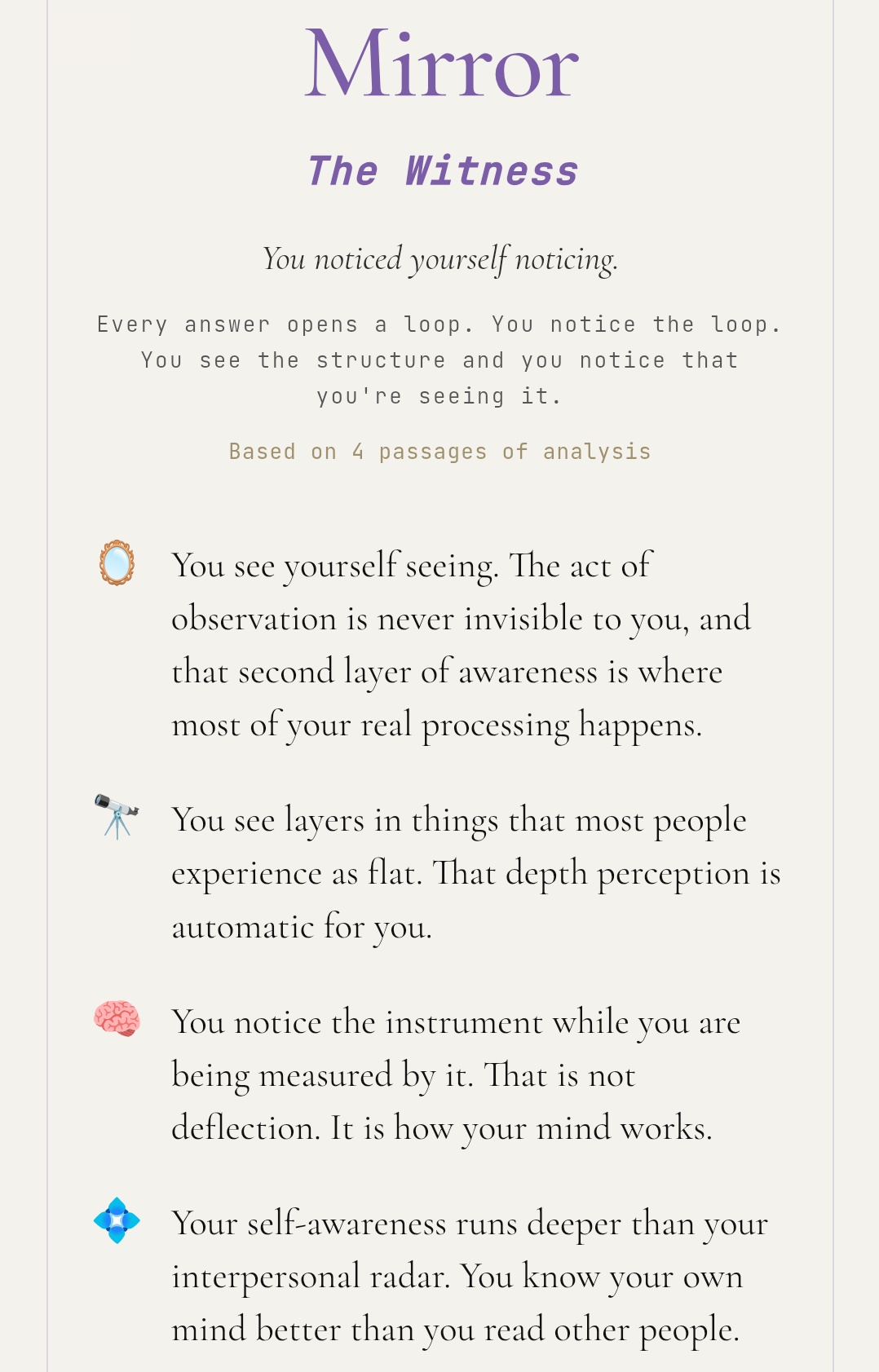
You see yourself seeing. The act of observation is never invisible to you, and that second layer of awareness is where most of your real processing happens.
The Analyst
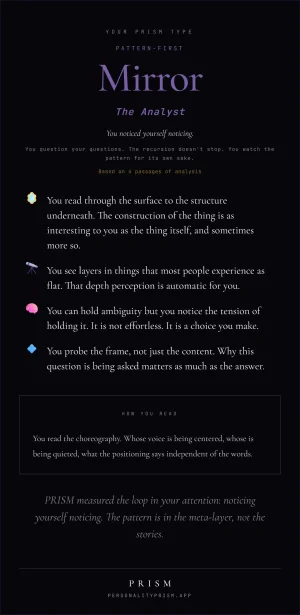
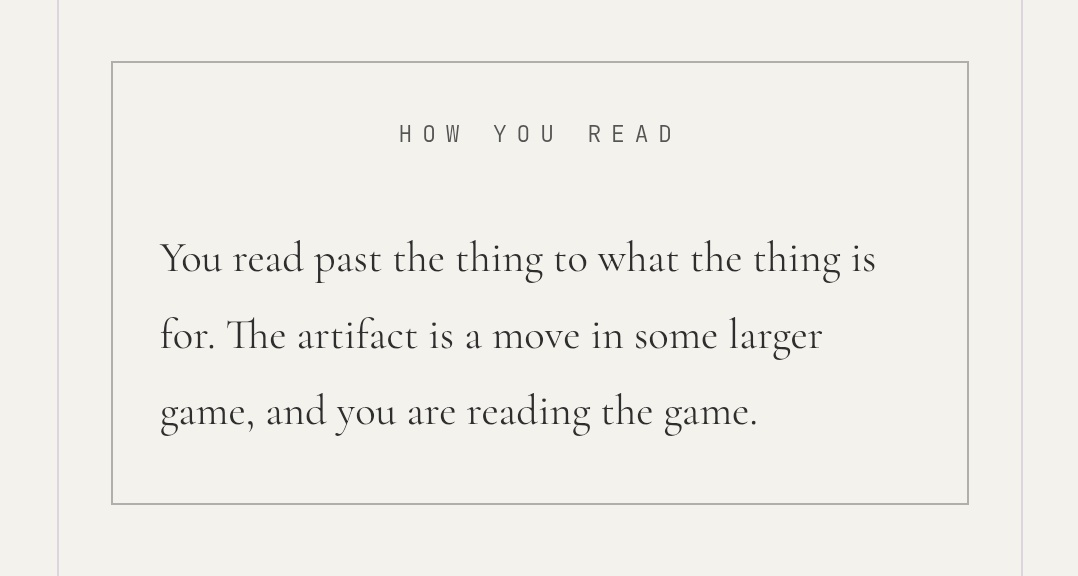
You read through the surface to the structure underneath. The construction of the thing is as interesting to you as the thing itself, and sometimes more so.
The Critic
You evaluate what you encounter against its own claims. If something says it's ambiguous, you check whether the ambiguity is earned. If it says it's moving, you check whether the craft supports the emotion. The assessment is automatic.
-------
You noticed the author before you noticed the story. The construction was visible, the choices deliberate, the intended effect transparent. You could see the scaffolding behind the scene before anyone else realized there was scaffolding. You're reading the decisions, not the content. What you walked past was the content itself. The character in the story was grieving. The grief was right there, in the pacing, in the word choices. You were so busy evaluating whether the grief was well-constructed that you didn't feel it.
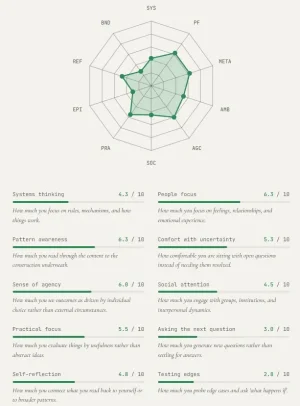
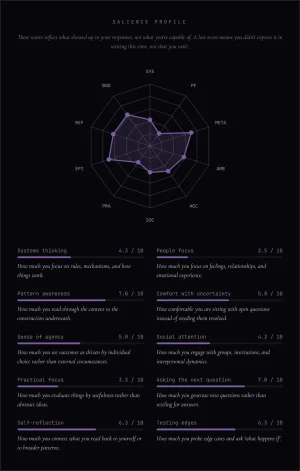
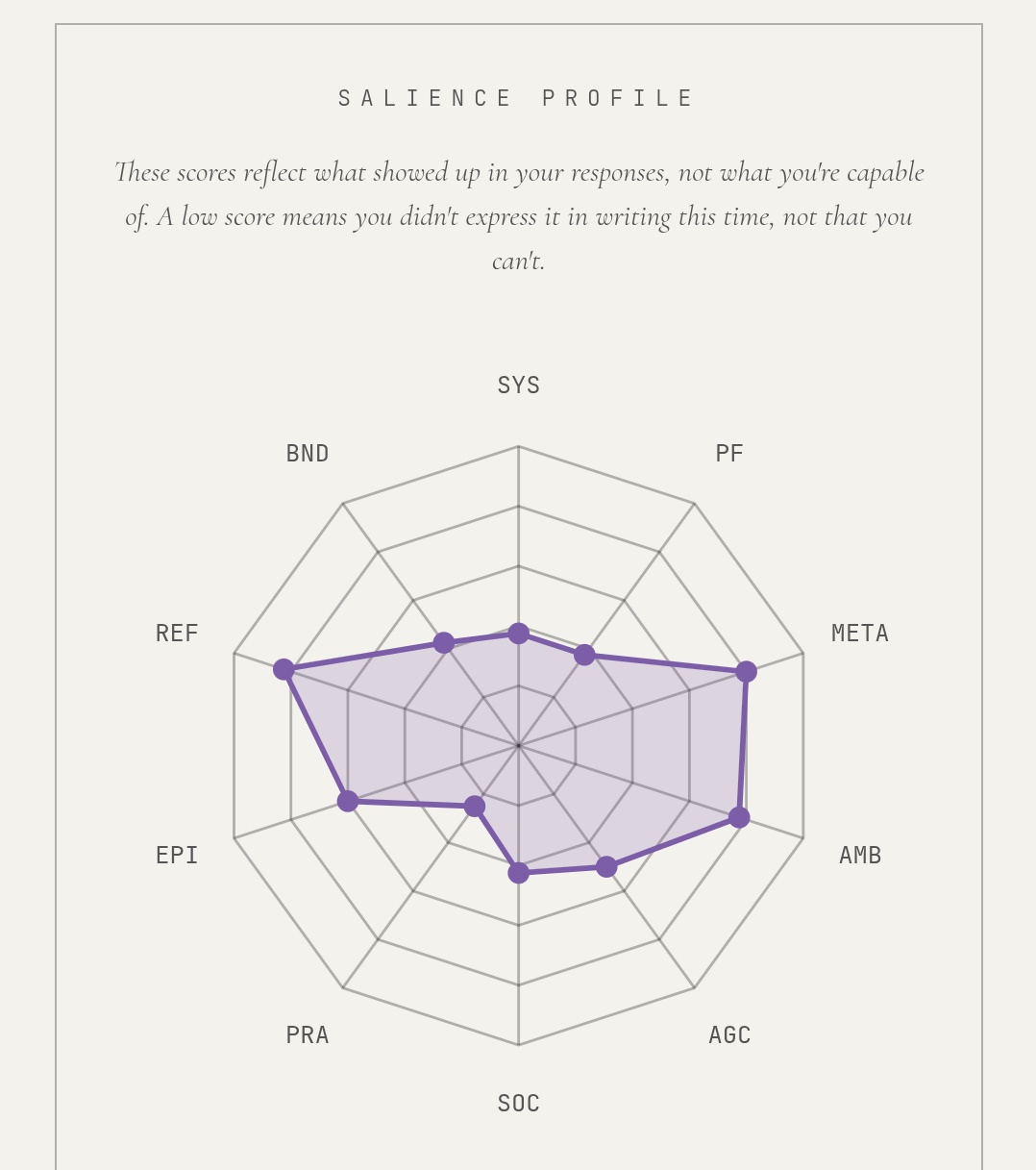
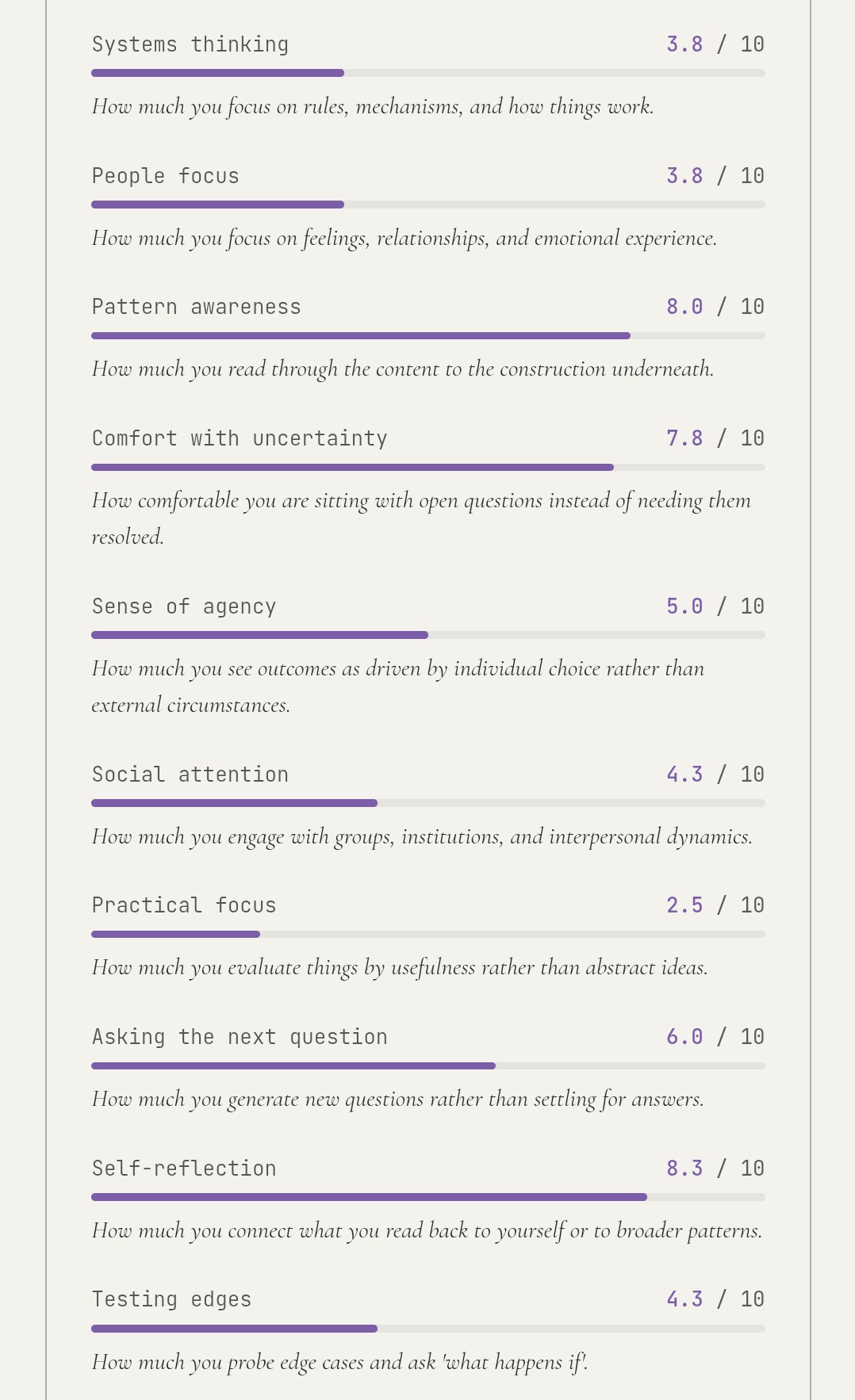
You see the patterns between things that other people experience as separate events. You're tracking the meta-level: what is this doing, why is it structured this way, what does the pattern across these four things reveal? This is genuine perception, not performance. But once you're reading the structure, you can't unread it to just experience the thing. You're always one level up, and getting back down isn't something you know how to do on purpose.
Someone told you something personal and you understood the shape of it perfectly. You could see what they were doing, why they were doing it, what need it served, how it connected to other things they'd said before. Your understanding was accurate and complete. It was also entirely from the outside. They wanted to be understood the way a friend understands a friend. You understood them the way a director understands a character, and you didn't notice the difference.
You caught yourself having an emotional reaction and immediately started analyzing why. Not suppressing it, analyzing it. The analysis is genuine curiosity, not avoidance. But the speed at which you pivot from feeling to examining the feeling means the feeling itself gets about three seconds of airtime before it becomes data. Other people let feelings run. You let them start, then pick them up and look at them. You learn a lot this way. You also don't always feel things all the way through.
You can tell when something is badly made. The film that manipulates instead of earns. The argument that sounds convincing but has a structural hole. The praise that's calibrated to flatter rather than describe. You see the mechanism behind the surface and it either delights you or infuriates you. What you miss is that most people aren't evaluating the mechanism. They're having the experience the mechanism was designed to produce. The film made them cry. The argument convinced them. Your ability to see through it isn't wrong. But it means you're having a different experience than everyone around you, and you can't always get back to theirs.
Cheers,
Ian



 personalityprism.app


 You see who is affected and you move toward them. The noticing and the acting happen together, not as separate steps.
 You track the group when it matters but you do not always lead with social awareness. It is a tool you use, not a lens you wear.
 You think about how things work and who they affect in roughly equal measure. Neither dominates consistently.
 You connect to others experiences without always routing through your own. The empathy is direct, not reflective.