
You are using an out of date browser. It may not display this or other websites correctly.
You should upgrade or use an alternative browser.
You should upgrade or use an alternative browser.
Metamodernism
- Thread starter Wyote
- Start date
More options
Who Replied?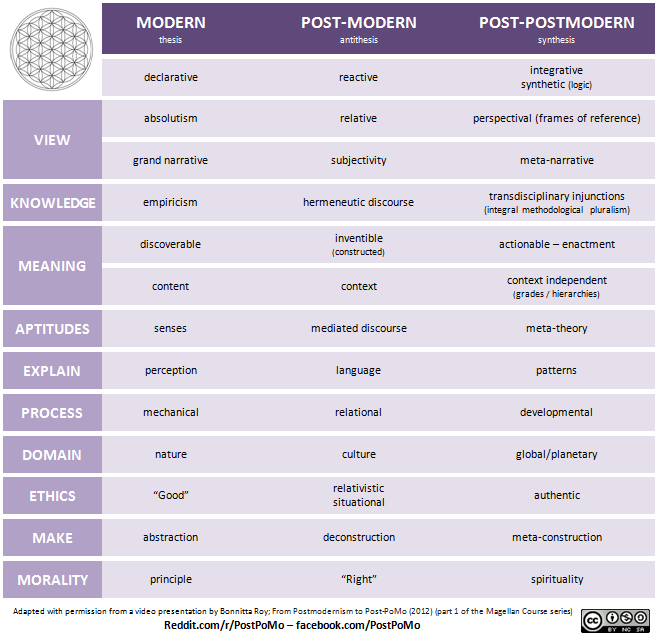

Sidis Coruscatis
Has Strong Opinions on Irrelevant Things
- MBTI
- INTJ
- Enneagram
- 964
Hierarchies? Grand narratives? Magical realism? Intention not to fulfill but attempt anyway? They're really dancing around the admission that maybe, Christianity was right.

- MBTI
- ENFP
- Enneagram
- 947 sx/sp
Anyone who mentions Ken Wilber, integral theory, and the idea of transcend-and-incorporate has my attention.
For me, this has been a guiding idea since the early ’90s, (from reading Wilber and) because I hated the modernity-lampooning cynical irony of the mid 1990s, which became the doomer ideology seed after 9/11, and the vine that bore fruit after the 2008 “downturn.”
Don’t throw out the baby with the bathwater—pare down, distill, recognize, value, integrate...all quadrants, all levels.
The wild oscillations are swings between points of truth, none more right or wrong—but there is a middle way.
And yes, this playfulness...the wink and smile...let me tell you my story, a story of a fool. Because I know everything, so let me prove it to you by showing you how tiny and nothing I am.
From a personal perspective, we’re all doomed—but I’m not my ego. I am the imp, the sprite, the jester. Let’s play...for a while...because everything seems frightening and overwhelming if you don’t get easy breezy.
Dangerous business, this...to recognize and honor this and that without picking a side (because they’ll pick a side for you if you let them!).
Care enough to let things go. What do you really need? What’s important when you’ve lost everything else? It has to be less than $10.
Cheers,
Ian
For me, this has been a guiding idea since the early ’90s, (from reading Wilber and) because I hated the modernity-lampooning cynical irony of the mid 1990s, which became the doomer ideology seed after 9/11, and the vine that bore fruit after the 2008 “downturn.”
Don’t throw out the baby with the bathwater—pare down, distill, recognize, value, integrate...all quadrants, all levels.
The wild oscillations are swings between points of truth, none more right or wrong—but there is a middle way.
And yes, this playfulness...the wink and smile...let me tell you my story, a story of a fool. Because I know everything, so let me prove it to you by showing you how tiny and nothing I am.
From a personal perspective, we’re all doomed—but I’m not my ego. I am the imp, the sprite, the jester. Let’s play...for a while...because everything seems frightening and overwhelming if you don’t get easy breezy.
Dangerous business, this...to recognize and honor this and that without picking a side (because they’ll pick a side for you if you let them!).
Care enough to let things go. What do you really need? What’s important when you’ve lost everything else? It has to be less than $10.
Cheers,
Ian
- MBTI
- ENFP
- Enneagram
- 947 sx/sp
I’m glad the graphic mentioned the term post-postmodern. That’s what it was called in the early ’90s.
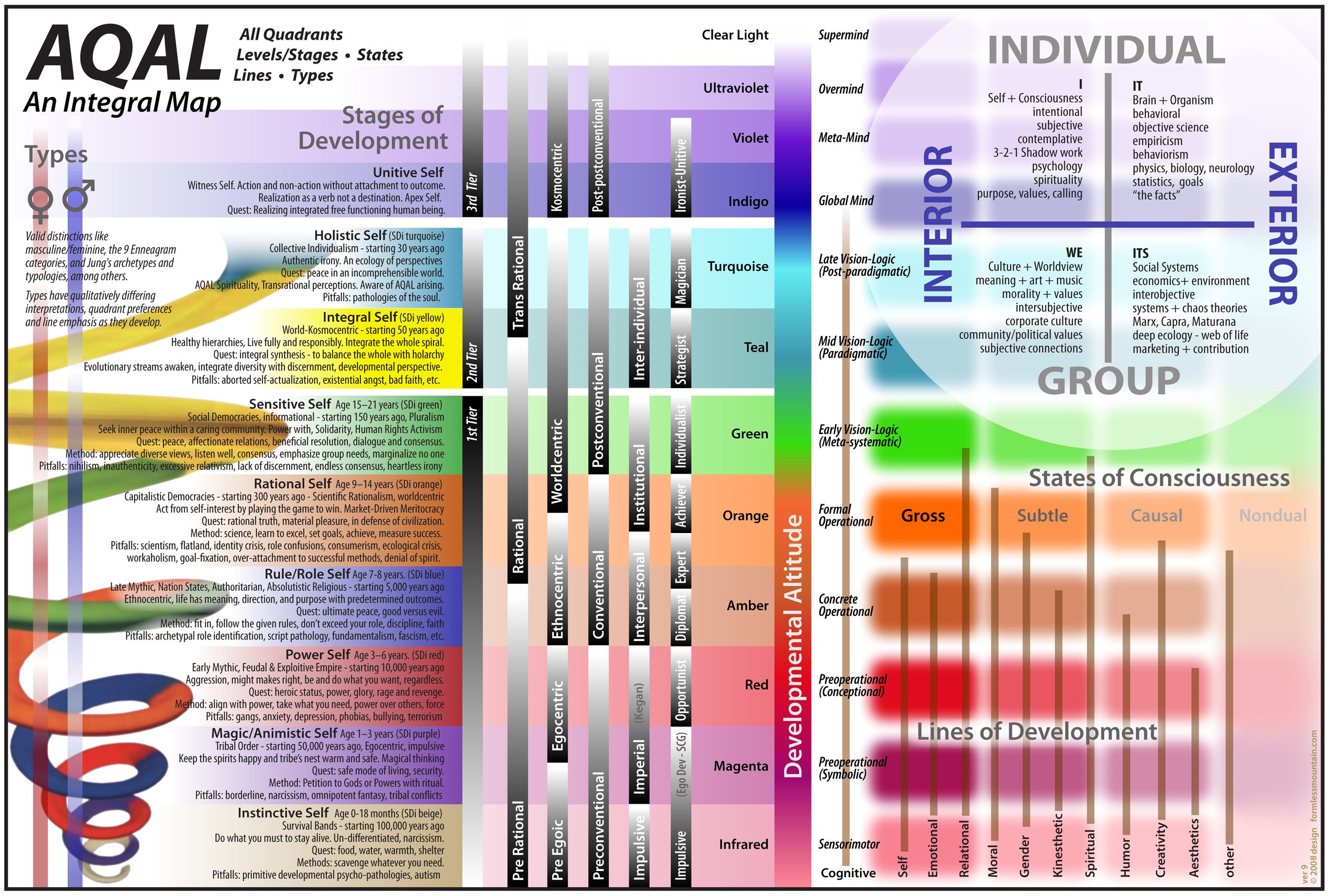
This is the uni-versal hierarchical web of halons ad infinitum. This is the time of the Intuitives. Our time. Won’t you please enjoy the show?
This is consciousness waking up, and recognizing itself.

Cheers,
Ian
This is the uni-versal hierarchical web of halons ad infinitum. This is the time of the Intuitives. Our time. Won’t you please enjoy the show?
This is consciousness waking up, and recognizing itself.
Cheers,
Ian

dZpADTLrPmX4c
Impermanent Fixture
- MBTI
- <3
Yikes I needa rush back to Sensorville for a moment
Sidis Coruscatis
Has Strong Opinions on Irrelevant Things
- MBTI
- INTJ
- Enneagram
- 964
What they don't tell you is that they ran out of space at the top to add "mastermind", also known as the INTJ. I'm just waiting in my cosmic mental palace for everyone to catch up.


Matty
Permanent Fixture
- MBTI
- Intj
These predominant philosophies seem like rationalisations of predominant psychological angsts.Discuss
In the era when people were less constrained by mere survival in rural areas, reliant on authority for guidance, modernism attempted to address angst about personal responsibility, perception, and acquisition of knowledge.
In a time when personal accountability, knowledge verification, and the exploding access to information made people once again subject to authority (the authority of scientific consensus, censorship, law enforcement, etc), postmodernism emerged. When the age of tinkering to figure things out for oneself came to an end, and modernist inventors gave way to researchers, no one could master everything for themselves, opening the angst which arises from being constantly subject to authoritative education: intellectual, and moral: the question of what makes one a distinct individual, among similar individuals came to the fore.
Finally, now that individual subjectivity, relativism, complete independence, and ultimately anonymity has been realised through cynicism about fashion (the hipster effect), and the internet (which reduces one's social value to something akin to clickbait), and there is no measurable threshold to what is considered "having made it", post postmodernism seems to be detaching from reality into the imaginary: the person is whatever he imagines himself to be.

- MBTI
- INFJ
- Enneagram
- 954 so/sx
These predominant philosophies seem like rationalisations of predominant psychological angsts.
I think on some level this is pretty accurate, yeah
- MBTI
- INFJ
- Enneagram
- 954 so/sx
They're really dancing around the admission that maybe, Christianity was right.
Embrace your savior, meta-christ
- MBTI
- INFJ
- Enneagram
- 954 so/sx

John K
Site Supporter
- MBTI
- INFJ
- Enneagram
- 5W4 549
My first, and totally inadequate reaction is that it sounds like what happens when a necessary yet impossible attempt is made to express and explore explicitly the response to a koan. But that’s probably true of all these sorts of dialectic tensions.Discuss
I wonder if it will do any better than it’s immediate precursors at dealing with the problem of Morgoth’s Ring - to use a metaphor that I think expresses the concept powerfully.

saint fushimi
Newbie
- MBTI
- INFJ
- Enneagram
- 4w3
I’m glad the graphic mentioned the term post-postmodern. That’s what it was called in the early ’90s.
This is the uni-versal hierarchical web of halons ad infinitum. This is the time of the Intuitives. Our time. Won’t you please enjoy the show?
This is consciousness waking up, and recognizing itself.
Cheers,
Ian
Great chart, lots of compelling ideas here. I particularly like the leftmost part, which describes how the maturation of a person is a microcosm of the whole of humanity. That's an idea i've been chewing on for a long time, and this is a more detailed version of my own thoughts. I think so much about microcosms, probably too much, but they are truly everywhere, on every level. It is like layers of infinities, fractals. It's extremely obvious to me that we are currently in the era that Nietzsche predicted, as the 'death of god.' It is the era of meaninglessness and nihilism, without guidance. I don't say this lightly, that it is the most unique time in all of human history. For the first time ever, the entire world is collectively lost. A niche is open, but right now we only see it as void. It is the unknown, and humans naturally fill the unknown with terror, in an effort to make it known. But the unknown is also infinite possibility.
The lack of significance in general society today is soul crushing, and most people do not understand-- but they can feel it. symptoms are everywhere, even in the smallest of places. Modern art and postmodern philosophy is worthless in itself, but essential as a part of the pendulum that humanity must always, frustratingly, follow. I think of it as a tide, slowly rising throughout the day. Each wave overshoots, then falls behind, but the water continues to rise. We are still rebelling unconsciously against the old dogmatic ways, and adopting relativism, but we are in an overshoot right now. It won't last forever though, and already I can see little signs of change, as people return to what was rejected in the rebellion, and this time take it voluntarily, adding it to the new, and moving another step towards balance.
- MBTI
- INFJ
- Enneagram
- 954 so/sx
For the first time ever, the entire world is collectively lost. A niche is open, but right now we only see it as void. It is the unknown, and humans naturally fill the unknown with terror, in an effort to make it known. But the unknown is also infinite possibility.


swampyyy
Two
- MBTI
- INFJ
- sampy_draws

Lao Tzunami
−2 enlightenment
- MBTI
- INFJ / IEI
As someone who does not feel at home in either modernism or postmodernism, I am eager to move past that polarization. I feel fortunate to live in the time of AI adoption because we all have the ability to shape the meta modernism that is emerging. I fall within all of the meta-modernism cells of your table except I do not see things context-independent.
However, when I hear philosophic YouTubers talking about metamodernism online, I don't like the synthesis they are offering. I don't like the "ironic sincerity", the "pendulum between absolute meaning and nihilism" and a lot of the metamodernism works or art and film feel wrong. However, I love Ken Wilber and his concept of holarchies and integral theory.
One of my highest values is the value life. I try to align myself with the spirit of adaptation, which is the spirit of learning, evolution and the feedback cycle between the will towards life and natural law.
One profound expression of that is parents raising their children. I never understood the Christian "God the Father", because that highest level of the divine wouldn't have a gender, and if there was the god of fathers, shouldn't there also be the god of mothers, and god the marriage? Putting that aside, I believe all genuine religions combination two things:
1. Parents living the best life they can, making mistakes, figuring out what works, and trying to transmit that to their children.
2. Communities of families living together, trying to synthesize and align their paths together into a tribe
Religions that have stood the test of time have to have the intergeneration and communal spirit of adaptation in them, which is at a minimum, what I see as value in them. And the purpose isn't just abstract, it is because I want to make the world better by having a good family some day, and I want to stack the deck as much in my favor so it doesn't end in divorce or traumatized kids.
Even if two things seem paradoxical, the good, the true and the beautiful in all things feels compatible. I want to learn to embody the good in both.
That isn't a jaded sarcasm swinging to earnestness and back (which honestly just sounds like dysregulation to me). What I am trying to do is find the transcendent center of two apparent opposites. For example, are pleasure and pain opposites? In a sense, but they are also visceral instincts that drive learning. One is a carrot, and the other is a stick. If I align myself with trying to learn as much as possible as quickly as possible, I can be grateful for my pain and pleasure while not being attached to either end of the spectrum.
However, when I hear philosophic YouTubers talking about metamodernism online, I don't like the synthesis they are offering. I don't like the "ironic sincerity", the "pendulum between absolute meaning and nihilism" and a lot of the metamodernism works or art and film feel wrong. However, I love Ken Wilber and his concept of holarchies and integral theory.
One of my highest values is the value life. I try to align myself with the spirit of adaptation, which is the spirit of learning, evolution and the feedback cycle between the will towards life and natural law.
One profound expression of that is parents raising their children. I never understood the Christian "God the Father", because that highest level of the divine wouldn't have a gender, and if there was the god of fathers, shouldn't there also be the god of mothers, and god the marriage? Putting that aside, I believe all genuine religions combination two things:
1. Parents living the best life they can, making mistakes, figuring out what works, and trying to transmit that to their children.
2. Communities of families living together, trying to synthesize and align their paths together into a tribe
Religions that have stood the test of time have to have the intergeneration and communal spirit of adaptation in them, which is at a minimum, what I see as value in them. And the purpose isn't just abstract, it is because I want to make the world better by having a good family some day, and I want to stack the deck as much in my favor so it doesn't end in divorce or traumatized kids.
Even if two things seem paradoxical, the good, the true and the beautiful in all things feels compatible. I want to learn to embody the good in both.
That isn't a jaded sarcasm swinging to earnestness and back (which honestly just sounds like dysregulation to me). What I am trying to do is find the transcendent center of two apparent opposites. For example, are pleasure and pain opposites? In a sense, but they are also visceral instincts that drive learning. One is a carrot, and the other is a stick. If I align myself with trying to learn as much as possible as quickly as possible, I can be grateful for my pain and pleasure while not being attached to either end of the spectrum.
Last edited:
- MBTI
- INFJ
- Enneagram
- 954 so/sx
Great post @Lao Tzunami
I think I generally align with you on most of what you said
My whole life has kinda been an adventure in reconciling polarities so any other insights are of interest to me
I think I generally align with you on most of what you said
My whole life has kinda been an adventure in reconciling polarities so any other insights are of interest to me
Lao Tzunami
−2 enlightenment
- MBTI
- INFJ / IEI
@Wyote, a few insights off the top of my head I've learned through experience:
- Differences between people becomes a problem when one person gets in the way of the other person pursuing their version of the good.
- Before projecting your standards onto another person, learn to see the world from their view, and try to live up to their own standards. It is impossibly hard, and if you succeed, your have created a path that integrates your good with their good, so they don't have to choose.
- We are not what we are at any point in time, we are what transforms us across time.
- We can extend our identity to anything we depend on for existence. In a sense, the planet Jupiter is an extension of our bodies, because without it, an asteroid would have wiped out life on earth.
- The divine exist in the space between two things. Your self does not exist in a specific neuron in your brain, but across the whole field of neurons. Likewise, there is a spirit between all things. That spirit is the origin of language.
- Every person is responsible for everything. If you don't want to do everything yourself, you have to distribute labor and work with other people, or simplify so there is less to do.
Last edited:
- MBTI
- INFJ
- Enneagram
- 954 so/sx
Before projecting your standards onto another person, learn to see the world from their view, and try to live up to their own standards. It is impossibly hard, and if you succeed, your have created a path that integrates your good with their good, so they don't have to choose.
I like this. Something to aim for.
Thanks for the rest as well.
Good personal insight.

meowzician
TL;DR Enthusiast
- MBTI
- INFJ
- Enneagram
- 4w5
I have developed a rule of thumb that I go by. Before I criticize a person's POV, make sure I can put that POV into my own words in a way that their response is, "Yes! You got it! That's what I'm saying." I do sometimes slip up, but that's what I aspire to.Before projecting your standards onto another person, learn to see the world from their view, and try to live up to their own standards.
When you combine our INFJ empathy and intuition, we are able to put ourselves into the shoes of other people in a way that very few people can. It's almost like we can add their experiences to our own. And as we continue to add all that data so that the sum total of our learned knowledge grows, our intuition has countless more dots it can connect than the average person. It gives us such an edge. And it gives us such a far greater responsibility. I agree with you. Everyone is responsible for everything.

Fruiteloop
Takes the Internet Very Seriously
- MBTI
- INFP
- Enneagram
- 7
I remember the transition between my sensitive self and integral self.
At 18 which is when I became meta-systematic I started to question epistemology. What does it mean to know something.
At age 28 I wrote a philosophy paper. Kinda like my magnum opus. It was paradigmatic.
As of yet I still need to focus on the unitive self.
The paper I made was theoretically about it but actually living it will take more refinement.
The other day looking up meditation and neuroscience information I came across ego development.
This is how I see it:
Self centric 7 (I exist)
Group centric 8 (people on tv exist)
skill centric 9 (discovered technology)
self determining 12 (began a.i. project)
self questioning 18 (focus on epistemology)
self actualizing 28 (wrote philosophy paper)
construct aware 38 (made models of psychology)
Unitive - witnessing
The last one is about the flux.
That energy just flows in and out.
This may lead to higher tiers but I suppose for me I just like learning.
Learning and interacting with people even if it is difficult at times.
At 18 which is when I became meta-systematic I started to question epistemology. What does it mean to know something.
At age 28 I wrote a philosophy paper. Kinda like my magnum opus. It was paradigmatic.
As of yet I still need to focus on the unitive self.
The paper I made was theoretically about it but actually living it will take more refinement.
The other day looking up meditation and neuroscience information I came across ego development.
This is how I see it:
Self centric 7 (I exist)
Group centric 8 (people on tv exist)
skill centric 9 (discovered technology)
self determining 12 (began a.i. project)
self questioning 18 (focus on epistemology)
self actualizing 28 (wrote philosophy paper)
construct aware 38 (made models of psychology)
Unitive - witnessing
The last one is about the flux.
That energy just flows in and out.
This may lead to higher tiers but I suppose for me I just like learning.
Learning and interacting with people even if it is difficult at times.


